Showing posts with label mo willems. Show all posts

Thursday, April 17, 2014

How I Sold My First Children's Book

An unexpected way into children's literature.


There’s a saying in Hollywood: There’s the way you’re supposed to make it, and the way everybody actually made it.

The same could easily be true of kidlit. The way it’s supposed to work is you submit your work to an editor or agent, they call you back and your book is sold. That’s it – clean, simple, wipe your hands and start your next book.

But not so fast. Consider these three.


  • Mo Willems went and won six Emmy’s as a writer for Sesame Street. That got him an agent. Two-and-a-half years later, he (and the Pigeon) had a book deal. That’s nearly two Emmy’s for every year he had to wait!
  • Jon Sciezska got thirty rejections for his first picture book. Then he found out his wife worked with the wife of an illustrator – Lane Smith. Lane agreed to illustrate his book, and one of the editors he’d already sent it to now decided she liked it. I can’t tell you how many rules were broken here (resubmitting? Having your own illustrator? My God!), but that’s how The True Story of the Three Little Pigs found its way into print.
  • Nick Bruel (Bad Kitty) was working in a bookstore when he noticed one woman always coming in and buying children’s books. When he asked her about it, she said she was a children’s literary agent. He said he had some illustrations he’d like to show her. That’s how he got his agent. No conferences, no referrals, no cold submissions. Just a book store and a lot of talent.

The story of how I got my first kidlit publishing contract isn’t so dramatic, but it does show there are other ways in the door. I answered an ad on a website. They said they were looking for writers to write children’s books about celebrities from the ‘40s and ‘50s. They already had Frank Sinatra, but were looking for others.

I thought about this for a while. I figured everyone would pitch Elvis or Marilyn, or maybe Deano to complement Frank. Maybe even the Duke. Who could I pitch that somebody else wouldn’t? Nat King Cole? Buffalo Bob? Trigger the Wonder Horse?

And that’s when it hit me – if there’s one celebrity from that era that children still know, it’s Judy Garland. Shirley Temple had faded, and so had Mickey Rooney. But The Wizard of Oz has kept Judy Garland in front of millions of kids, even today. And that’s how I pitched them.

Seven days later, I was asked to draw up an outline for the book based around the Frank Sinatra model. I did, and four days later, they hired me.

But here’s where it gets really interesting: they wanted three books at three different levels – K-1, 2-3, 4-5. The books were not going to be sold to the public, but were to be distributed to long-term care patients. And it was a flat-fee freelance job with no royalties or advances or future books.

Nothing glamorous. No pigeons driving buses; no wolves setting the record straight, or bad kitties flipping through the alphabet, just three biographies on Judy Garland. But it counts. That’s my entre into children’s publishing, and I’m thrilled to be there. It goes in every query letter I send out – you know, while I’m trying to land that editor or agent. 

Because that’s how you’re supposed to do it…

Even when you’re not.

Friday, October 18, 2013

The Best Picture Books Featuring Exotic Animals


Here are some picture book animals that defy common wisdom.

What do you think of when you think “exotic animal?” Alpacas? Komodo dragons? Marmosets? Pythons? Blue-tongued skinks and Argentinean tegus? Sure, those are exotic. But in the picture book world, so are tigers, salamanders, slugs and bobwhites. Why? Because they don’t sell.

In picture book language, exotic animals are any animals that don’t sell well, no matter how common they are. This is why we see plenty of picture books that feature cats, dogs, cows, ducks, and monkeys. Kids know them and love them. Familiarity breeds cash.

Now, this doesn’t apply to non-fiction picture books, which are designed to teach young readers about capybara, geckos, three-toed sloths and the unfortunate albatross. But when it comes to fiction, making an “exotic” animal your hero often leads to a rejection letter that says they love the story, but could you make the main character a duck? Or anything else you’ll find on Old MacDonald farm.

So here’s a list of some authors who took a chance on strange little critters and found (great) commercial success.

Top Exotic Creatures in Picture Books

  1. Wombats. These are a recent arrival on the picture book scene, but have proven immensely popular and may become an “it” animal, thanks largely to Charles Fuge’s delightful “Little Wombat” series. Following in those cute footsteps is Wombat Walkabout by Carol Diggery Shields. It contains enough Australian slang to make any wombat homesick. And you know your species has arrived when it earns its own holiday book. Christmas Wombat by Jackie French gives us the high holidays Down Under
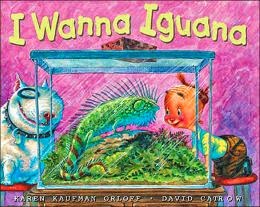
  2. Iguana. Another animal rarely seen in picture books, but popping up more often is the iguana. T.E. Watson’s (2001) and Karen Kaufman Orloff’s (2004) two different I Wanna Iguana books might make any kid actually want an iguana, and Orloff’s has now launched an entire “I Wanna” series. There’s also Mañana Iguana (Ann Whitford Paul), which gives the desert lizard a Mexican flair, and Private I. Guana (Nina Laden) that gives the little-seen lizard a detective license and air of mystery.
  3. Llama. There aren’t many books that feature a llama, but what Anna Dewdney started has led to a wildly popular series. There’s Llama Llama Red Pajama and Llama Llama Mad at Mama and a whole bunch more. Llama is fun to say, rhymes
    with plenty of words and, unlike wombats and iguanas, hasn’t inspired a lot of imitators.
  4. Naked Mole Rat. And coming in as the most exotic animal in picture book fiction is the naked mole rat. Any surprise? Mo Willems’ Naked Mole Rat Gets Dressed is the only fiction picture book to feature the naked mole rat because even Mo struggled to make them cute (of course, he succeeded!). And even though he has several series under his belt (Pigeon, Elephant and Piggie, Cat the Cat), he’s resisted any pressure to create Naked Mole Rat Plays Dress Up, Naked Mole Rat Goes Trick or Treating or Naked Mole Rat with Nothing but the Radio On.

So exotic animals can be blue jays or cardinals, but not pandas or lions. In picture book parlance, an exotic animal is anything that doesn’t sell – until it does. I’m thrilled that some authors and publishers have defied convention, and I hope we’ll see more exotic animals like bandicoots or bush babies in picture books. Who knows? It just might get kids to read some of those small-selling non-fiction books about their new favorite (and strangely exotic) animal!


Sunday, October 21, 2012

What Book Changed Your Life?


Last weekend, at the Rutgers One-on-One Conference, author Bruce Coville discussed a fan letter he had received. A reader credited him with her decision to join the Peace Corps. She loved his book so much, she even cited it in her application essay. It’s clear that My Teacher Is an Alien changed that young woman’s life.

Everyone has a book like that, one that absolutely changed your life. I remember the greatest compliment I ever received came from an African-American actress, Dee Watson, who said, “You’d make a good Atticus Finch.”

Why was that the greatest compliment? Because To Kill a Mockingbird changed my life.  It has stayed with me decades after I first read it, and while it’s impossible to live up to the standard set by Atticus, it’s not impossible to model your life after the example set out in Harper Lee’s masterpiece.

Life-changing books  are common in young adult stories as teens enter their formative years. It’s also true of books like To Kill a Mockingbird, originally written for adults but that serve as de facto YA on high-school reading lists. Lives, decisions, and character are shaped every year by classics like Black Like Me, 1984, Pride & Prejudice, Crime & Punishment, etc. And no list, no matter how complete, includes the thousands of picture books, middle-grade and
YA titles children cling to every day.

Fortunately, adults can find books that reach them, too; maybe even make them see the world in a whole  new way. I recently re-read Tommy Moore’s A Ph.D. in Happiness From the Great Comedians. It lifts your spirits in a way far beyond “the healing power of humor;” it can change your entire outlook by presenting practical steps drawn from the world of stand-up comedy. It my case, it even justifies the years I spent in comedy and the fact that humor remains my primary tool for dealing with problems and reaching people. One book – a how-to book taken from the ways legendary comics view and treat the world – really can help you understand how you can live your life.

But it’s children’s authors and their books that have the biggest influence. Adult personalities are largely shaped and readers seek out books of interest to them, but children, particularly young children, are an (largely) empty canvas. They’ll face new ideas, new concepts, new challenges. They’ll read a book ten times (or have it read to them!) and still pick it up an 11th time. Even books that aren’t particularly challenging but that are delightful nonetheless – Fox in Socks, Don’t Let the Pigeon Drive the Bus, etc. – still create lifelong readers.

So whether it’s My Friend Flicka, Tom Sawyer, Encyclopedia Brown, Nancy Drew or something no one has heard of (or you’re too ashamed to admit – hey, I loved The Five Chinese Brothers as a kid), there was a book that changed your life.

So let me know – what book changed your life?

Tuesday, December 13, 2011

KidLit Buzzwords: What Does It Mean to Be Commercially Unpublishable?

It’s one thing to be unpublishable; it’s another to be commercially unpublishable.

Unpublishable means you can’t write. The work is drivel and probably deserves a place in the dustbin.

Commercially unpublishable means you can write, your work is really good and probably deserves a place in the dustbin.

Commercially unpublishable is far more kind and perhaps that’s why it’s being tossed around so much. It came up at least twice at the 2011 Rutgers One on One, and I’d heard it used several times before that.

What Commercially Unpublishable Means in Children’s Literature

Commercially unpublishable means that there’s no demand in the market for it. This doesn’t mean the piece isn’t good; it doesn’t even mean the intended audience wouldn’t love. It’s just that agents or editors don’t see a place fore it in the market. Take this example:

A picture book is written for children 5-8 years old. The intended audience will love it, says the editor or agent, but the picture book market for 5-8 year olds is dead because parents believe children that age should be reading chapter books so they can start getting ready for college.

Five or ten years ago, that manuscript might have been publishable. It’s well-written, has a great story arc and follows certain picture book precepts. It might even be publishable in another 5 years, if the market changes. But right now, it’s commercially unpublishable.

Consider other "dead" children’s markets:

Young Adult: vampires (market is glutted)

Middle Grade: historical fiction (sales down)

Picture books: Halloween (market is glutted), rhyming books

At least that’s what I’ve been told by various editors. They simply aren’t looking for them, though they always add the caveat: “Of course, there’s always room in the market if it’s well done.”

Which is the point Jon Sciezska, Harold Underdown and others made at Rutgers : it’s only commercially unpublishable until it’s published and someone buys it. Sciezska struggled to publish The True Story of the 3 Little Pigs, but it turned out it was commercial after all. Mo Willems struggled to see Don’t Let the Pigeon Drive the Bus in print and then it took off, launched a series, and spawned a terrific career.

The market may not have known it, but it was commercially publishable after all.

Summary: Commercially unpublishable is frustrating but not as bad as unpublishable. At least it means you can write, but the market has no idea what to do with you.

Or so  I've been told.
Good luck!


Tuesday, April 26, 2011

Balzer and Bray on the Brain

In Honor of New Releases From Balzer + Bray

I’ve been thinking a lot about Balzer & Bray lately. I like the work they do, at least the picture books and middle grade I know. They have two of my favorite authors in Mo Willems and Bob Shea, and two editors who’ve been nothing but nice to me in Ruta Rimas and Alessandra Balzer (yep, one half of B+B).

So I’m kind of excited about this post. No analysis, no breakdowns, just books I love.

The first up is Bob Shea’s I’m a Shark. Shea is the master of the braggadocios four-year old with a whimsical touch of vulnerability. I’m a Shark is every bit as good as Dinosaur vs. Bedtime. Clipped phrases, a boastful main character, with lots of dialogue. An easy read aloud or an easy reader, whichever works best for your little dinosaur (or shark).

The plot: Shark isn’t afraid of anything. Well, there is that one thing, but… I can’t give away the punchline. Let’s just say adults will find Shea’s ending accurate and comical, and children will see more than a little bit of Shark in themselves.

I saw Alessandra discuss (OK, dissect) this book at the SCBWI Winter Conference in New York. Knew from that moment I was going to have to study it. More on the dilemma this presents in my next post).

Mo Willems has a habit of creating characters that can anchor an entire series: Pigeon, Elephant and Piggie, Cat the Cat, and so on. This times he takes a shortcut and puts his series in just one book: a collection of short stories featuring Amanda and her Alligator. Hooray for Amanda & Her Alligator! centers on an imaginative, impulsive child whose best friend is a stuffed alligator. I think I also encountered this book in NYC and found it adorable. (Yes, grown men can use that word when discussing children’s books.)

Amanda has a wild side in her, reminiscent of Pigeon, but there’s a soft side, too, like Piggie. Hard to put all that in a picture book, but Mo does it again.

Both I’m a Shark and Hooray for Amanda & her Alligator! were released today. The third book I’d like to discuss isn’t available until May 3rd: Eric Luper’s Jeremy Bender and the Cupcake Cadets.

Eric’s second book with Balzer + Bray is also his first middle grade. I’ve taken an interest in middle grade lately since Ruta suggested I give it a shot. So will do. I’ll be picking up Eric’s book at Hudson Children’s Book Festival on May 7th. Can’t wait to see him again (and read about Jeremy Bender!).

In the meantime, here’s the book trailer. Enjoy Eric, times two.